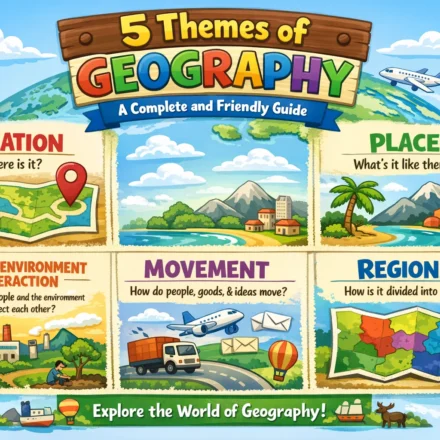


The 5 themes of geography are a simple and powerful way to understand our world. Whether you’re learning about a small town or a big country, these five themes help you see how places are connected and why they matter. In this article, you’ll explore the 5 themes of geography in a clear, easy, and engaging way. By the end, you’ll feel confident using them in school, daily life, and even when traveling.
Let’s dive in and explore how geography becomes exciting when you understand these five key ideas!
What Are the 5 Themes of Geography?
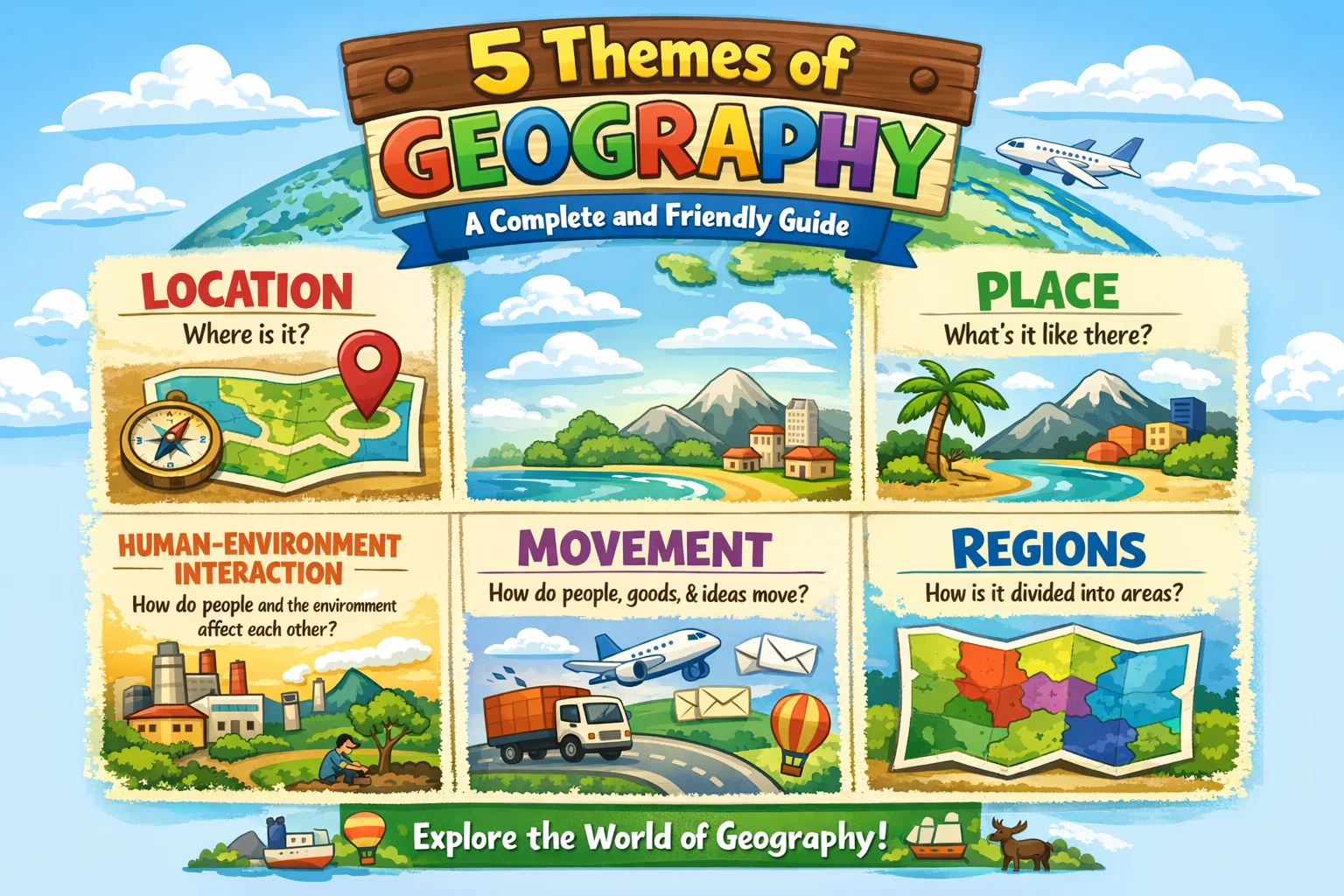
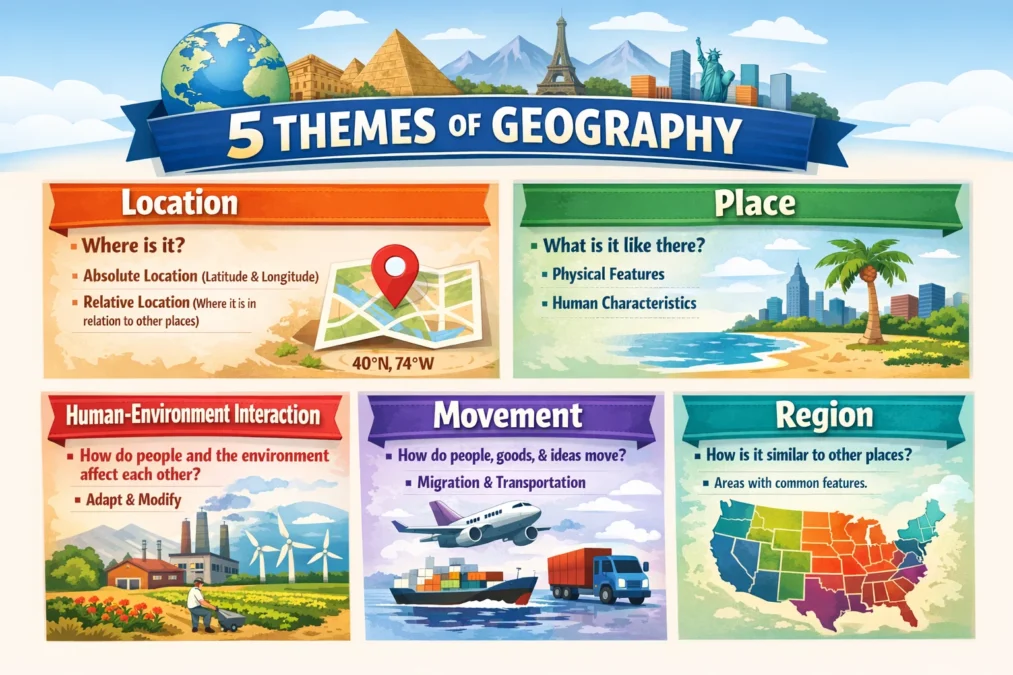
The 5 themes of geography are five main concepts used by geographers to study Earth. They were created to help people better understand places and how humans interact with them.
These five themes are:
- Location
- Place
- Human-Environment Interaction
- Movement
- Region
Each theme answers important questions about the world around us. Together, they paint a full picture of any place on Earth.
Why Are the 5 Themes of Geography Important?
The 5 themes of geography are important because they:
- Help us understand our surroundings
- Explain how people live and work in different places
- Show how nature and humans affect each other
- Make it easier to study maps and countries
- Build critical thinking skills
In simple words, these themes turn geography into a story about people, places, and connections.
Location: Where Is It?
Location is the first and most basic theme of the 5 themes of geography. It answers the question: Where is a place?
There are two types of location:
Absolute Location
This is the exact position of a place on Earth using coordinates like latitude and longitude.
- Example: A city’s exact position on a map
- Uses numbers and coordinates
Relative Location
This describes a place using nearby landmarks or places.
- Example: “Next to a river” or “north of a city”
- Uses directions and descriptions
Location helps us find places quickly and understand how they connect to other areas.
Place: What Is It Like There?
The second theme of the 5 themes of geography is place. It answers: What is this place like?
Place includes both physical and human features.
Physical Features
These are natural things, such as:
- Mountains
- Rivers
- Climate
- Soil
Human Features
These are things made by people, such as:
- Buildings
- Roads
- Culture
- Language
For example, a desert and a rainforest are very different places because of their physical features. At the same time, cities differ because of culture and traditions.
Human-Environment Interaction: How Do People and Nature Affect Each Other?
This theme explores how humans and the environment work together. It’s one of the most interesting parts of the 5 themes of geography.
There are three main ways this happens:
People Depend on the Environment
- We need water, food, and air to survive
- Farmers depend on soil and weather
People Adapt to the Environment
- Wearing warm clothes in cold areas
- Building houses on stilts in flood-prone areas
People Modify the Environment
- Building roads and cities
- Cutting down forests
- Creating dams
This theme shows that humans and nature are closely connected—what we do affects the planet.
Movement: How Do People, Goods, and Ideas Move?
Movement is another key part of the 5 themes of geography. It answers: How do things move from place to place?
Movement includes:
- People traveling (migration)
- Goods being traded (imports and exports)
- Ideas spreading (culture, language, technology)
Examples of Movement
- People moving to cities for jobs
- Food being shipped to different countries
- Music and fashion spreading worldwide
Movement connects the world, making it feel smaller and more united.
Region: How Are Places Similar or Different?
Region is the last theme of the 5 themes of geography. It groups places based on shared features.
There are three types of regions:
Formal Regions
- Have clear boundaries
- Share one main feature
- Example: A country or state
Functional Regions
- Organized around a central point
- Example: A city and its surrounding areas
Perceptual Regions
- Based on people’s opinions
- Example: “The Middle East” or “The South”
Regions help us organize the world into smaller, easier-to-understand parts.
Table: Summary of the 5 Themes of Geography
| Theme | Key Question | Main Idea | Example |
|---|---|---|---|
| Location | Where is it? | Position on Earth | Coordinates or directions |
| Place | What is it like? | Physical and human features | Climate, buildings, culture |
| Human-Environment Interaction | How do humans and nature interact? | Depend, adapt, modify | Farming, construction |
| Movement | How do things move? | Flow of people, goods, ideas | Travel, trade, communication |
| Region | How are places similar? | Grouping areas by traits | Countries, cultural areas |
Real-Life Examples of the 5 Themes of Geography
Let’s look at how the 5 themes of geography work together in real life.
Example: A Coastal City
- Location: Near the ocean
- Place: Warm climate, sandy beaches
- Human-Environment Interaction: Fishing and tourism
- Movement: Ships and travelers arrive daily
- Region: Part of a coastal region
This shows how all five themes help us understand one place fully.
How Students Can Use the 5 Themes of Geography
Students can use the 5 themes of geography in many ways:
- To study maps more easily
- To write better geography essays
- To understand global issues
- To explore new places with confidence
Here’s a simple trick: whenever you learn about a place, ask five questions—one for each theme!
Common Mistakes to Avoid
When learning the 5 themes of geography, watch out for these mistakes:
- Confusing location with place
- Forgetting human features in “place”
- Ignoring how humans affect nature
- Mixing up regions
Don’t worry—practice makes perfect!
Fun Ways to Learn the 5 Themes of Geography
Learning the 5 themes of geography doesn’t have to be boring. Try these fun ideas:
- Use maps and globes
- Watch travel videos
- Play geography games
- Explore your local area
You can even apply these themes to your own neighborhood!
The Role of the 5 Themes of Geography in Modern Life
In today’s world, the 5 themes of geography are more useful than ever.
They help us:
- Understand climate change
- Study global trade
- Learn about cultures
- Solve environmental problems
From planning cities to protecting nature, these themes guide important decisions.
Final Thoughts on the 5 Themes of Geography
The 5 themes of geography are like a toolkit for understanding the world. They make complex ideas simple and help us see how everything is connected. From location to region, each theme plays a key role in explaining how our planet works.
By using the 5 themes of geography, you can explore any place with confidence and curiosity. So next time you look at a map or travel somewhere new, remember these five themes—they’ll help you see the world in a whole new way!